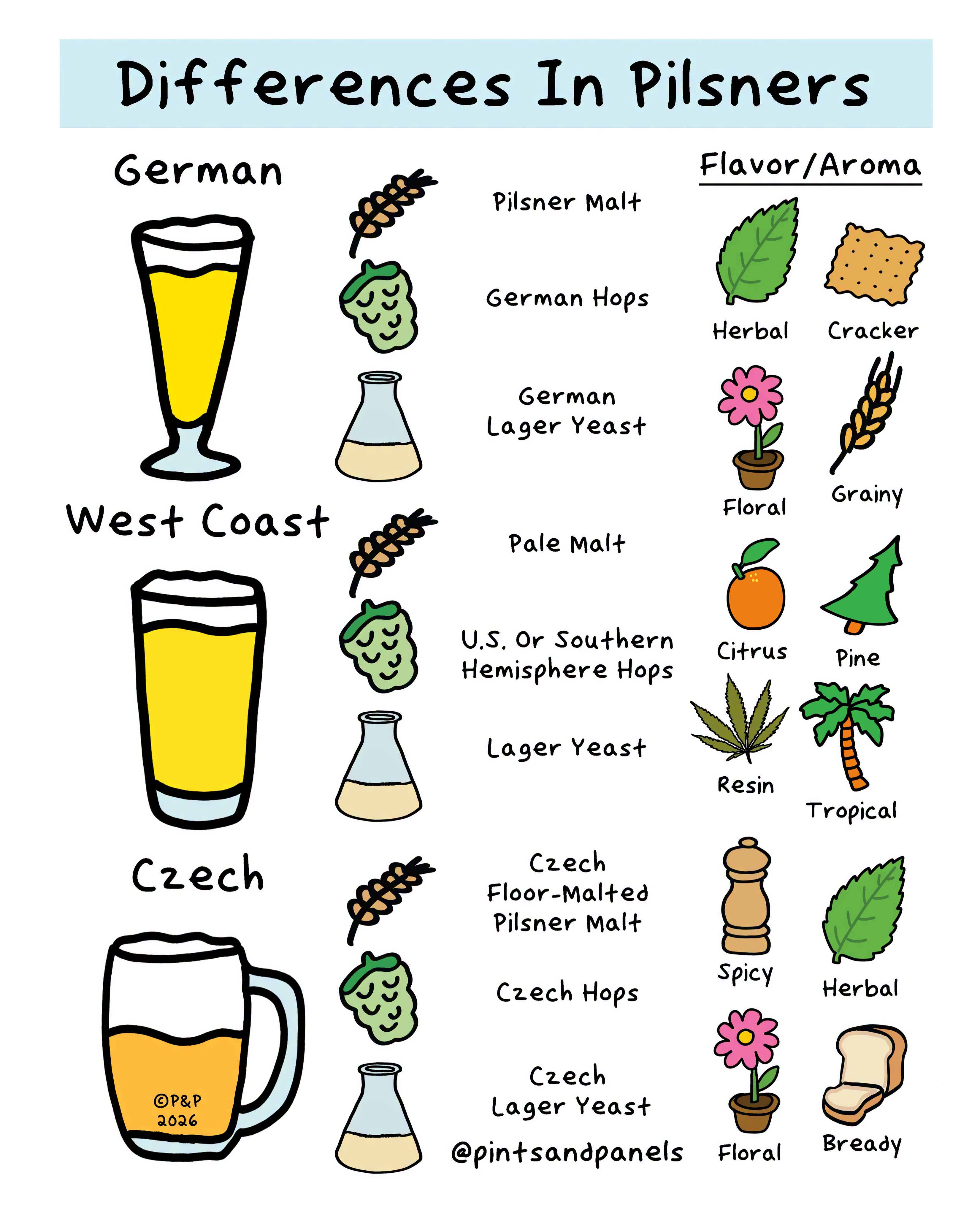
I recently came across a graphic on social media explaining the differences between three types of Pilsner: Czech, German and West Coast. (see pic from Pints and Panels)
My immediate response was probably a little predictable for anyone who knows me:
Czech is the Urquell — the original — and still the best.
German Pils? A poor second.
And West Coast Pilsner?
Well, now you’ve got me started.
Because while I actually enjoy drinking many of these beers, I have a problem with calling them Pilsners.
And yes, before someone races to the comments section, I know the Brewers Association now officially recognises West Coast-Style Pilsener.
I still don’t like it.
First, what exactly is a Pilsner?
To understand my objection, we need to go back to where the whole thing started.
In 1842, in the Bohemian city of Plzeň — or Pilsen — Bavarian brewer Josef Groll brewed the beer that would fundamentally change the beer world.
That beer survives today as Pilsner Urquell.
The word Urquell essentially means “original source”, which is particularly appropriate because this is where the Pilsner story begins.
The combination of pale malt, local Saaz hops, soft water and bottom-fermenting lager yeast produced something dramatically different from many of the darker beers common at the time.
It was pale. It was brilliantly clear. It had a beautiful white head, noticeable bitterness and wonderful spicy, floral hop character.
More than 180 years later, Pilsner Urquell remains one of the benchmarks of the style.
The current BJCP guidelines classify it as a Czech Premium Pale Lager, describing the style as having considerable malt and hop character, with rich, complex, bready maltiness combined with pronounced but soft bitterness and floral and spicy hop flavours.
Traditional Czech hops, Czech malt and Czech lager yeast are all listed as characteristic ingredients.
That’s a Pilsner.
Then the Germans got involved
As tends to happen with good ideas, somebody else eventually had a crack at it.
German brewers adapted the Czech Pilsner to their own ingredients, water and brewing traditions, with German versions emerging during the 1870s.
The result became what we now know as German Pils.
It’s related to the Czech original, but it’s certainly not identical.
According to the BJCP, German Pils is generally lighter in body and colour, drier, crisper and more fully attenuated than Czech Premium Pale Lager. It also tends to have a more lingering bitterness and higher carbonation.
Traditional examples use Continental Pilsner malt, German hops and a clean German lager yeast.
Interestingly, the BJCP even notes that the term “Pils” is more commonly used in Germany than “Pilsner” to differentiate the German beer from the Czech style — and, according to some, out of respect for the original.
I rather like that.
So now we have two closely related beers.
Czech Pilsner: richer, rounder and maltier, with that beautiful soft bitterness.
German Pils: lighter, drier, crisper and sharper.
I know which one I’m choosing.
But both clearly belong to the same family.
And then America said: “Hold my beer”
Enter the West Coast Pilsner.
This is where things get interesting.
Take the clean fermentation and drinkability of a lager, then introduce the sort of modern American, Australian and New Zealand hop character normally associated with contemporary pale ales and IPAs.
Citrus. Tropical fruit. Pine. Resin. Dankness.
Often plenty of dry hopping.
The result can be absolutely delicious.
In fact, I’ve had some cracking examples.
My argument isn’t that West Coast Pilsners are bad beers.
Quite the opposite.
My problem is the name.
Is it really a Pilsner?
Here’s where beer style definitions become fascinating.
The BJCP currently recognises Czech Premium Pale Lager and German Pils within the Pilsner family, but doesn’t have a specific West Coast Pilsner category.
The Brewers Association, however, does.
Its 2026 Beer Style Guidelines include West Coast-Style Pilsener, describing beers designed to combine the drinkability of Pilsner with assertive Pacific Northwest and Southern Hemisphere hop character. The style allows modern IPA-type hops and significant dry hopping, with bitterness between 30 and 50 IBUs.
So technically, if somebody tells me West Coast Pilsner is now an officially recognised beer style, they’re right.
Damn it.
But that doesn’t completely settle the argument.
Because style guidelines don’t create beer history. They attempt to describe what brewers are actually making.
The Brewers Association itself explains that its guidelines evolve in response to changes in the commercial beer market. In announcing its 2026 guidelines, it specifically referred to West Coast-Style Pilsener as one of the emerging styles it had added in recent years.
In other words, enough brewers started calling these beers West Coast Pilsners that eventually the terminology became established.
That’s how beer evolves.
But I’m still allowed to hate the name.
What happened to Pilsner malt?
One of the things that particularly caught my attention in the original graphic was the suggestion that a German Pilsner uses Pilsner malt, a Czech Pilsner uses Czech floor-malted Pilsner malt…
…and a West Coast Pilsner uses pale malt.
Hang on.
We’re calling something a Pilsner while deliberately moving away from one of the ingredients most closely associated with Pilsner?
To be fair, the official Brewers Association definition isn’t quite that restrictive. Its West Coast-Style Pilsener guideline says the malt character may include Pilsner malt characteristics, rather than insisting on one particular grist.
But this gets to the heart of my objection.
At what point does changing a traditional style turn it into something else?
If we change the malt, change the hops, dramatically increase the hop aroma, start dry hopping it with varieties producing tropical fruit, citrus, pine and resin…
…how much Pilsner needs to remain before we stop calling it Pilsner?
Why not call it a West Coast Lager?
That’s the name I would prefer.
West Coast Lager.
It tells me exactly what I’m getting.
A clean, crisp, highly drinkable lager with the expressive modern hop character associated with the American West Coast brewing tradition.
I’d happily order one.
I’d probably order another one.
And I wouldn’t spend the entire time muttering about beer terminology.
Calling it a West Coast Lager also gives the beer its own identity rather than borrowing one from a brewing tradition stretching back to Plzeň in 1842.
Of course, beer styles have never stood still.
American IPA evolved from British IPA.
New Zealand Pilsners introduced New World hop varieties into lager brewing.
Italian Pilsners embraced dry hopping while retaining a strong connection to European Pilsner traditions.
Brewers constantly borrow, modify and reinterpret ideas.
That’s one of the things that makes beer so interesting.
But names still matter.
They tell us something about what is in the glass, where the beer came from and what the brewer is trying to achieve.
So am I just being a beer traditionalist?
Probably.
And I’m quite comfortable with that.
Beer innovation is important. Without brewers experimenting with established styles, we’d miss out on some fantastic beers.
But I also think there’s value in protecting the meaning behind historic beer styles.
Pilsner isn’t simply another word for pale lager.
It represents a particular branch of brewing history that started in Plzeň and subsequently inspired German Pils and eventually countless pale lagers around the world.
So when I see a heavily dry-hopped lager packed with American or Southern Hemisphere hops called a West Coast Pilsner, part of me still thinks:
That’s a West Coast Lager.
And probably a bloody good one.
Just don’t call it a Pilsner.
As for Czech versus German?
I’ll give the Germans credit for producing some magnificent examples.
But if you’re asking me where the crown belongs, I’m heading back to where it all started.
Pilsner Urquell. The original — and still the best.
What do you reckon? Is West Coast Pilsner a legitimate evolution of the style, or should we just call it a West Coast Lager?